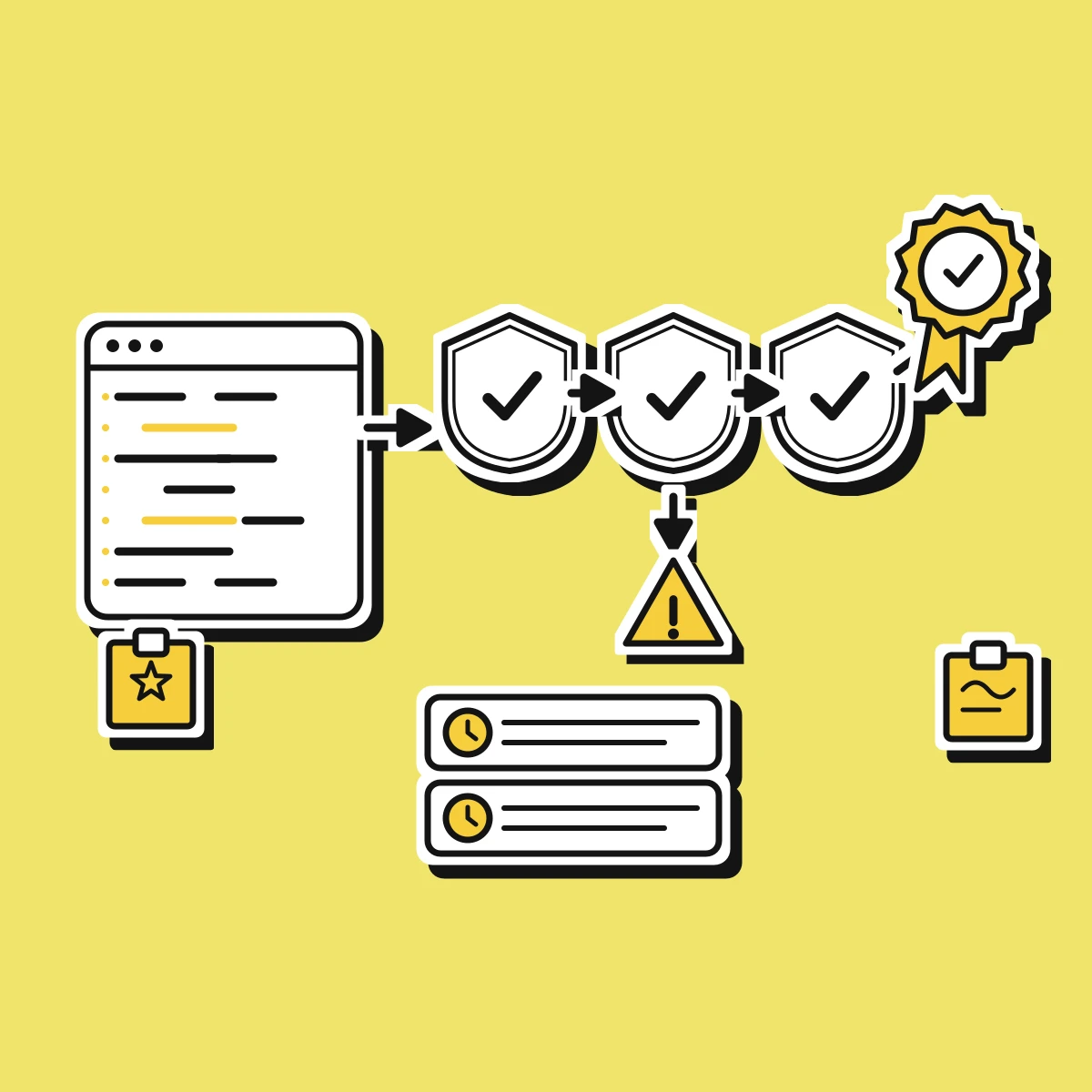
When AI starts writing more of your code, your CI pipeline is the first automated line that has to hold. Human review is stretched by volume, so more of the load shifts to the gates that run on every change. The problem is that most pipelines were tuned for a world where a person wrote the code and understood it. AI breaks that assumption in ways your existing gates were never designed to catch.
We work with engineering teams retuning their pipelines for AI-assisted work, and the pattern is consistent. The old gates still matter, but on their own they give a false sense of safety, because AI is unusually good at producing code that passes them while being subtly wrong. The job is not to add more gates. It is to make the gates catch the failures AI actually introduces.
How AI changes what the pipeline has to catch
Three shifts matter for CI specifically.
- Volume goes up. More changes per day flow through the same pipeline, so anything the pipeline misses, it now misses more often.
- Polish goes up. AI output is clean, consistently named, and well-commented. It clears style and lint gates effortlessly, which makes those green checks less informative than they look.
- Failure modes shift. AI is prone to specific mistakes: tests that pass without asserting anything real, plausible-but-wrong solutions to a nearby problem, regenerated logic that duplicates what already exists, and unnecessary new dependencies. A pipeline built to catch human errors does not automatically catch these.
The throughline: AI is very good at passing checks. That is exactly why the checks need to test substance, not surface.
The gates that earn their place
Map each gate to a specific AI failure it is meant to catch. If a gate does not catch something AI gets wrong, it is hygiene, not a safety control.
| Gate | AI failure it catches | Why it matters more now |
|---|---|---|
| Test coverage with mutation testing | Tests that pass without asserting real behaviour | AI loves to write a test that turns green. Mutation testing checks the test would fail if the code were wrong. |
| Dependency and licence scanning | Unnecessary or unvetted packages, copyleft contamination | AI pulls in dependencies and patterns freely; this catches what it added without anyone deciding to. |
| Secret scanning | Hard-coded credentials in generated code | Models reproduce secret-shaped patterns from training and context; this is a hard gate, not a warning. |
| Security/SAST scanning | Plausible code with real vulnerabilities | Polished output hides injection, auth, and data-handling flaws that look fine on read. |
| Duplication detection | Regenerated logic instead of reusing what exists | AI re-solves solved problems; this surfaces the drift before the codebase bloats. |
Notice what is doing the work here: not the presence of tests, but whether the tests prove anything. Coverage percentage is the metric AI games most easily, because it is trivial to generate a test that executes a line without checking what it does.
The gates that give false confidence
Some checks feel like quality gates and mostly are not, once AI is involved.
- Raw coverage percentage. A number that goes up while assertion quality goes down. Use it as a floor, never as evidence the change is tested. Pair it with mutation testing or it lies to you.
- Lint and formatting passing. AI output sails through. A green lint check now tells you almost nothing about correctness; treat it as table stakes, not a signal.
- "Tests are green." The most dangerous one, because it feels conclusive. Green tests prove the tests passed, not that they would have failed if the behaviour were wrong. With AI authoring tests, that gap is wider than it has ever been.
None of these should be removed. They should be demoted: necessary, not sufficient, and never the thing that lets a change through unwatched.
Gate by risk, not uniformly
Running every gate at full strength on every change is how the pipeline becomes the bottleneck AI was supposed to relieve. Route gate depth by what the change touches.
| Change type | Touches | Gate depth |
|---|---|---|
| Low risk | Docs, tests, isolated UI copy | Fast gates only; trust and move |
| Standard | Feature code with clear blast radius | Full automated suite, normal thresholds |
| High risk | Auth, payments, data handling, migrations, public APIs | Full suite plus mutation testing, deeper SAST, required human review |
The point is to spend your slow, expensive gates where a miss is expensive. AI raises volume across every row; the high-risk row is where weak gates actually hurt you.
Keep the human gate, and aim it
Automated gates do not replace review; they decide what review should spend its attention on. The pipeline's real job is to clear the mechanical questions (does it build, are there secrets, do the tests assert anything, did it pull in something new) so the human reviewer can spend their scarce attention on the question no gate answers: *is this solving the right problem, and does someone understand why it works?*
When CI does the mechanical checking well, review gets faster and better, because the reviewer is no longer hunting for missing tests or stray secrets. They are reading for intent. That division of labour is the whole point.
Our view
AI does not let you automate quality. It changes what automation has to look for. The pipeline that worked when humans wrote and understood the code gives false confidence when a model writes it, because AI is unusually good at producing code that is green and wrong.
Retune the gates to catch AI's actual failure modes (tests that assert nothing, plausible-but-wrong logic, smuggled dependencies, hidden vulnerabilities), and demote the checks AI passes effortlessly from "evidence" to "hygiene." Gate by risk so the pipeline does not become the bottleneck. And keep the human reviewer for the one question automation cannot answer.
Green CI should mean the change is safe to merge. After AI, that is only true if your gates test substance instead of surface. Making sure they do is the work.
Sources
- DORA,
Accelerate State of DevOps, on change failure rate and continuous delivery, accessed 2026-06-11 - OWASP,
OWASP Top 10 for Large Language Model Applications, accessed 2026-06-11 - Google Engineering Practices,
Code Review Developer Guide, accessed 2026-06-11
Frequently asked questions
- What quality gates should you add for AI-generated code?
- Gates that catch AI's actual failure modes: mutation testing to confirm tests would fail if the code were wrong, dependency and licence scanning for packages it pulled in, secret scanning for hard-coded credentials, SAST for plausible-but-vulnerable code, and duplication detection for logic it regenerated instead of reusing.
- Does passing tests mean AI-generated code is safe?
- No. Green tests prove the tests passed, not that they would have failed if the behaviour were wrong. AI is very good at producing a test that turns green without asserting anything real, so 'tests are green' is necessary but not sufficient. Pair coverage with mutation testing to check the tests actually prove something.
- Why is code coverage misleading for AI-generated code?
- Coverage measures which lines a test executes, not whether the test checks what those lines do. It is trivial for a model to generate a test that runs a line without asserting its behaviour, so coverage can rise while real test quality falls. Use it as a floor, never as evidence a change is tested.
- How do you keep CI from becoming a bottleneck with AI code?
- Gate by risk rather than uniformly. Run only fast gates on low-risk changes like docs and isolated UI copy, the full automated suite on standard feature code, and the deepest gates — mutation testing, deeper SAST, required human review — only on high-risk changes to auth, payments, data handling, migrations, and public APIs.